
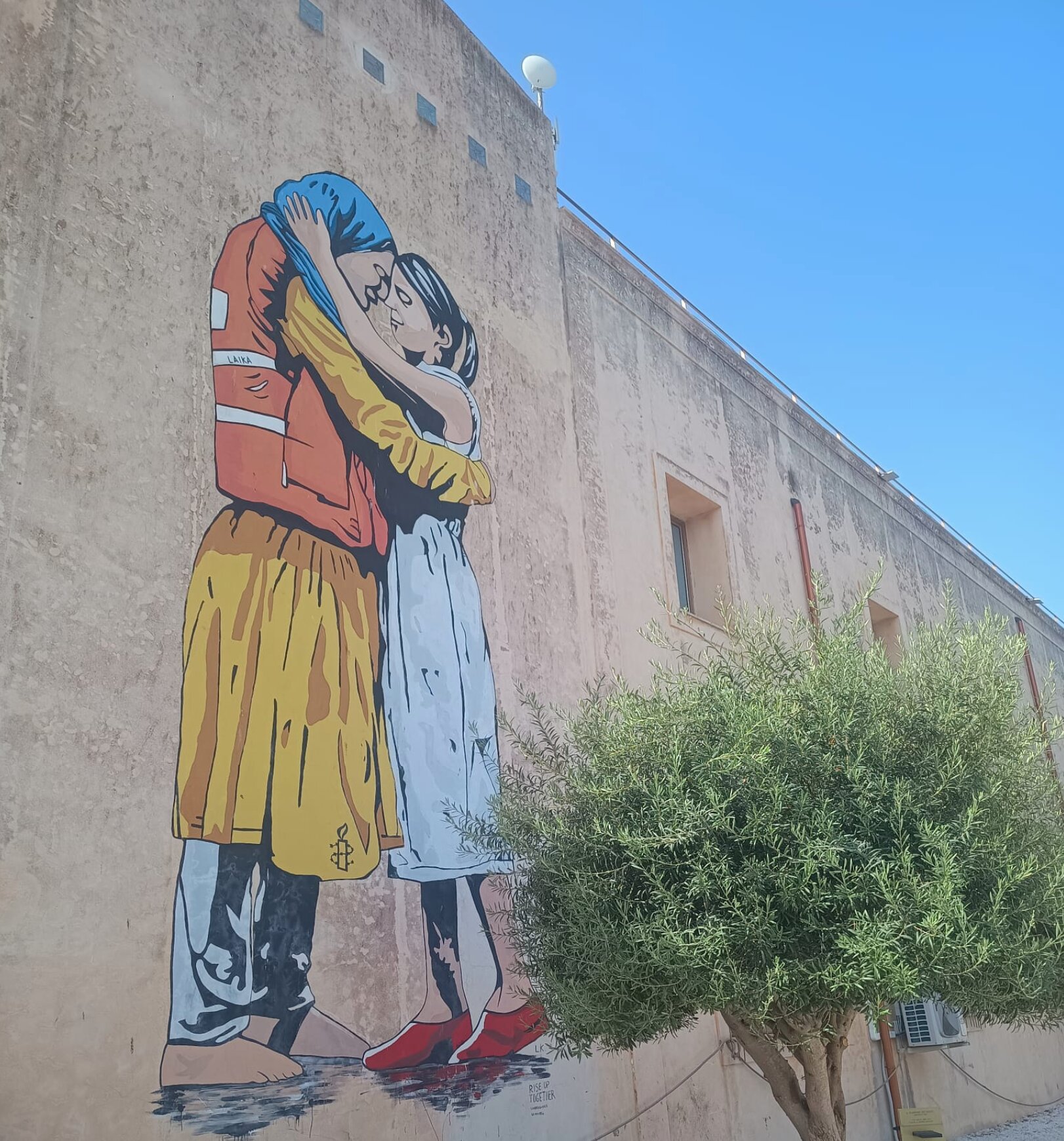
Original feature article published on July 31, 2026, in CTXT magazine.
“Are you with Frontex?” It was one of the first questions I was asked after landing on the island. At the time, it surprised me; only later did I begin to understand why someone might mistake me for one of its officers.
The explanation came from Agostino, an ambitious young man to whom I had recounted that first encounter and who offered to show me around Lampedusa in his red 1984 Fiat Panda: no wing mirrors, windows that could barely be rolled up, and seat belts in more than questionable condition.
As we drove towards the north of the island, he suddenly turned to me with a half-smile and pointed to a man on the other side of the road. “Look at that man. He’s definitely with Frontex. He’s wearing civilian clothes, but he’s tall, blond, serious… they’re usually like that.”
His comment, halfway between a joke and a deeply rooted perception on the island, offered a first clue to Frontex’s silent yet recognisable presence in the everyday life of Lampedusa.
I had not, however, arrived there as an officer. Once again, I had travelled to a destination to research cooperation in contexts of crisis and conflict, but above all I was driven by a far more basic question: what was really happening in Lampedusa, Europe’s southernmost border, facing the African continent?
I had come to observe, listen and try to understand the island. It was necessary to approach a reality that could hardly be contained within any simple framework.
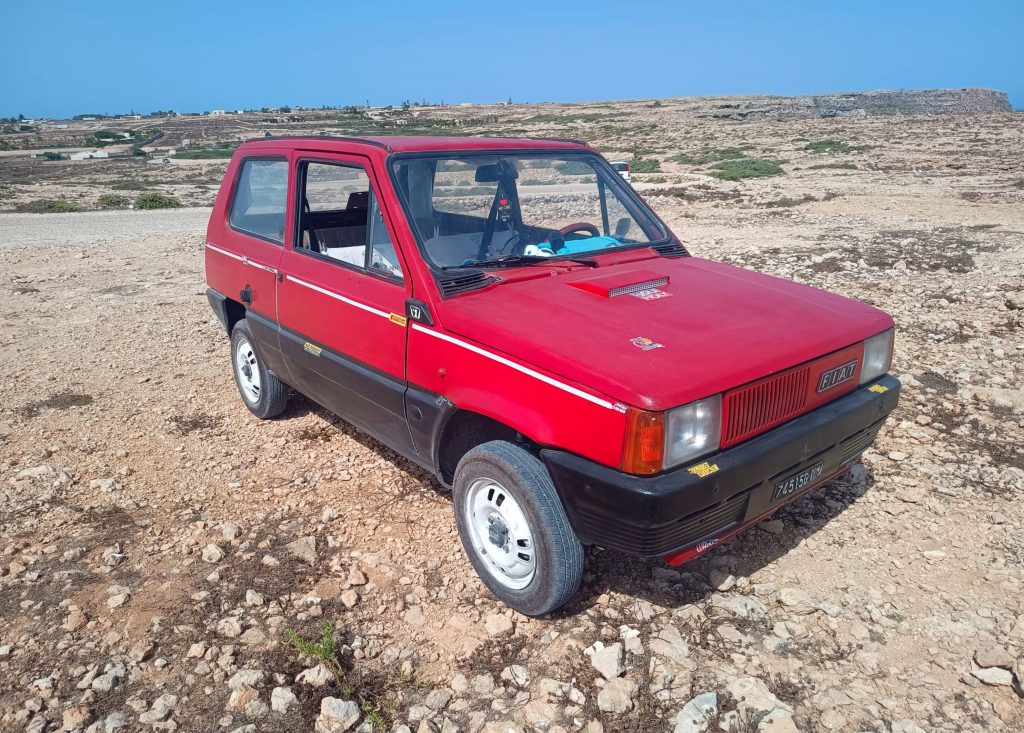
Fiat Panda de Agostino – © Foto Leonard Glab Frontera
In Lampedusa, two worlds coexist, crossing paths every day yet barely touching. On one side is the world of migration and its management: Frontex, the Coast Guard, the Guardia di Finanza, the police, NGOs, and the people who risk their lives attempting to cross the Mediterranean. The latter travel at least 140 kilometres in small boats after setting out from Libya or Tunisia, hoping to find a safe place to live.
On the other side are the island’s inhabitants, who live in a place that resembles paradise, try to preserve their everyday lives, and depend heavily on the intense flow of tourism. Two realities connected to one another, concentrated on an island barely eleven kilometres long, perched on a handful of rocks, with almost no trees or shade, at the boundary between Africa and Europe. Connected, but not shared. Proximity alone does not create an encounter.
Yet it would also be unfair to reduce the people of Lampedusa to mere spectators of someone else’s tragedy. They live within that contradiction, not outside it. The island depends on tourism, on its beaches, its crowded restaurants, and an image of tranquillity that sustains much of everyday life. At the same time, its inhabitants have lived for years alongside landings, shipwrecks, helicopters, patrols, and reports of people missing at sea.
Some have taken part in rescue operations, others have offered help, and many have learned to carry on with their lives while, only a few kilometres away, someone is fighting to preserve theirs. This is not necessarily indifference, but also a form of self-protection: no community can remain indefinitely in a state of emergency. Normality then becomes a necessity, but also a risk, because it allows the exceptional gradually to become part of the landscape.
When I arrived, I sat at the entrance to the harbour for the entire afternoon and simply watched. Dozens of yachts carrying tourists came and went. Coast Guard patrol boats departed. Frontex drones and helicopters arrived. Fighter jets crossed the sky. Armoured vehicles belonging to the Carabinieri and the police moved through the streets, mingling with the constant noise of the island’s many Vespas.
Everything coexisted within the same space: tourism, surveillance and everyday life, but also, at least to me, the permanent possibility of another tragedy. It was a strange scene and, at the same time, perhaps an honest image of Europe today.
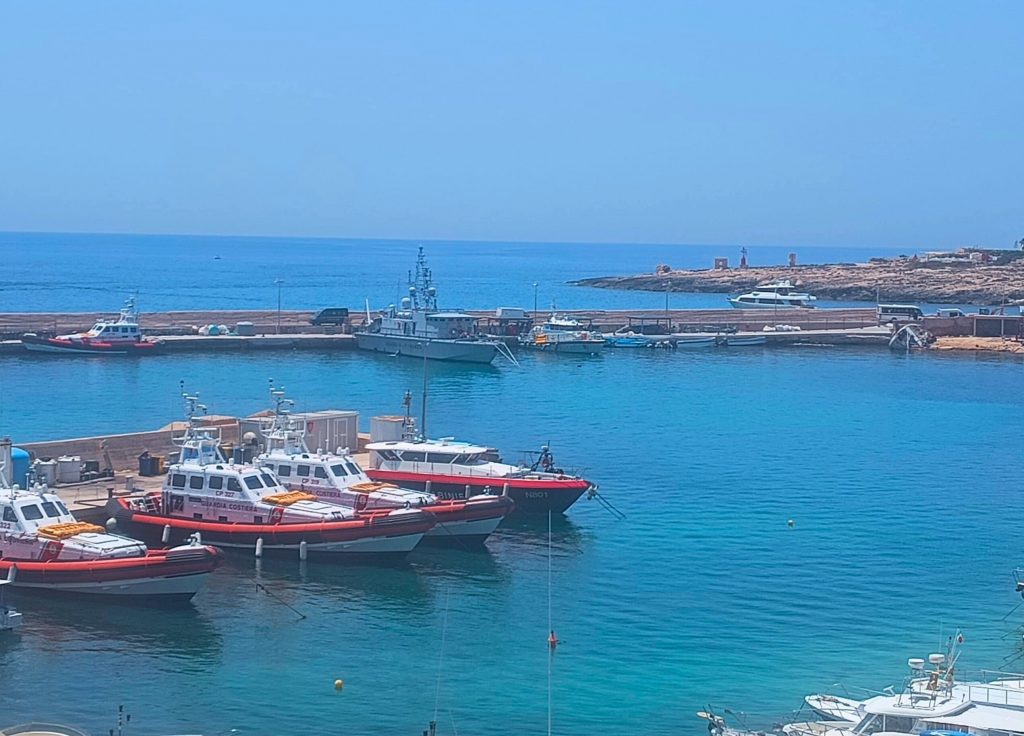
Puerto Lampedusa – © Foto Leonard Glab Frontera
That same afternoon, July 14, one of the vessels entering the harbour was a Coast Guard ship towing a wooden boat. Boats of this kind often end up piled together and half-submerged beside Molo Papa Francesco.
Thirty-eight people had reached Lampedusa alive, where the Carabinieri, Frontex, medical personnel and representatives of various humanitarian organisations were already waiting for them. They had been located a few hours earlier off the island, divided between two boats. One had departed from Zuwara, Libya, carrying 32 people from Somalia and Sudan—two countries marked by war, violence and torture—including nine minors. The other had left the Tunisian region of Mahdia and was carrying six Tunisian nationals.
I later learned that, on that same day, while I was still on my way, another wooden boat had capsized off the eastern coast of Libya. It was carrying around sixty people, including women and children, and sank near the island of El-Bardaa. Only ten people survived.
Two events occurring on the same day, connected by the same route and separated only by chance—and by whether they could be found in time.
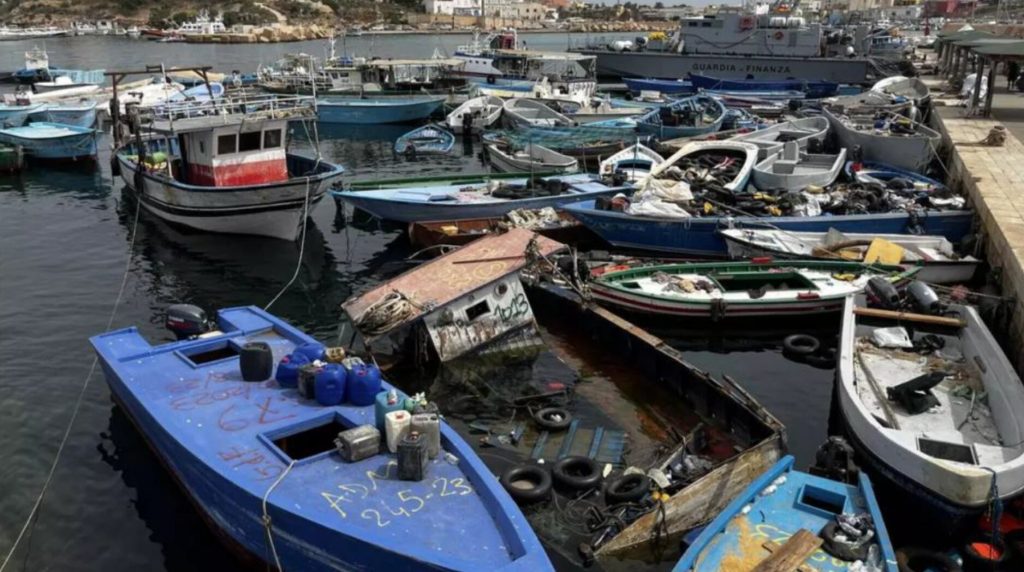
Molo Papa Francesco – © Foto G.S. / EFE
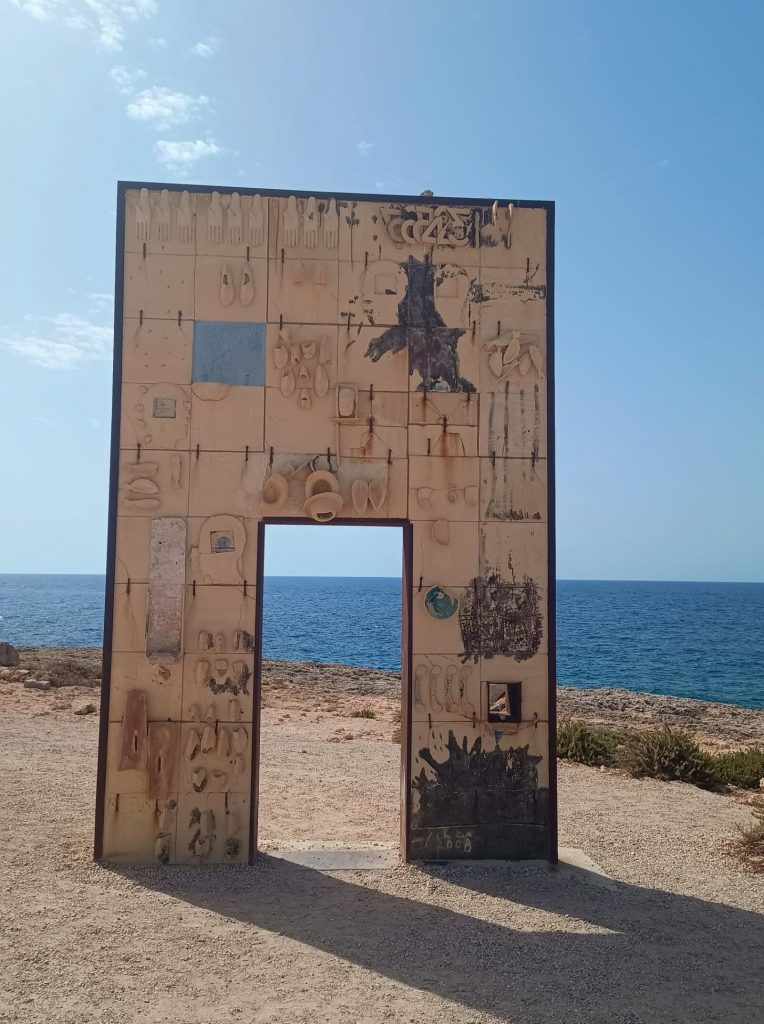
Few places I have visited during my expeditions bring beauty and horror together as intensely as Lampedusa. And few embody this paradox as clearly as the Gateway to Europe, located directly beneath the airport. The monument faces the sea, its doorway opening towards the place from which boats arrive—and where so many others disappear.
Beside the Gateway to Europe, several bunkers and small craters caused by explosions during the Second World War still remain. They are remnants of another era, yet the past left its wounds here, and the present continues to open new ones, some even deeper.
But Lampedusa’s paradox is found not only in its monuments, or in the two opposing realities that coexist on the island; it is contained in the land itself. Geologically, the island lies on the African continental shelf, and Africa is closer than Sicily. This does not alter its political or administrative status as part of the Italian state since 1861, nor its membership of the European Economic Community—now the European Union—since 1958. It forms Europe’s southernmost external border.
This African land, transformed into a European gateway, was a refuge before it became a border. For centuries, it was a place of contact, passage and shelter for those navigating the Mediterranean: fishermen, merchants, travellers and shipwreck survivors. Before becoming a tightly controlled frontier, the island was, in a sense, a shared land for those who managed to reach it.
The legend of Andrea Anfossi belongs to that past and helps us understand it. According to the story, the sailor was shipwrecked and stranded on Lampedusa. A divine light guided him to an image of the Virgin Mary. With his own hands, he built a small boat and used the image as a sail, allowing him to return to sea and save himself. It is the story of a man who arrived as a castaway, found refuge on the island and was able to leave thanks to what the island provided.
Today, shipwreck survivors still arrive, although their reception is now part of a carefully organised procedure. Those rescued may reach the harbour aboard civilian vessels operated by organisations such as Open Arms, Sea Punks or Sea-Watch, or they may be transported by the Coast Guard.
It is difficult not to notice a significant absence here: the European Union has aerial surveillance, drones and extensive border-control mechanisms, but no permanent humanitarian mission specifically dedicated to searching for and rescuing people in the central Mediterranean. Although national authorities and Frontex intervene when they detect an emergency, a substantial part of this work continues to fall to civil-society organisations, sustained by donations and by the efforts of professionals and volunteers.
At the quay, those rescued receive initial medical attention and are registered. Depending on the operation, organisations such as Mediterranean Hope, Amnesty International, UNHCR, Médecins Sans Frontières or the International Organization for Migration may be present.
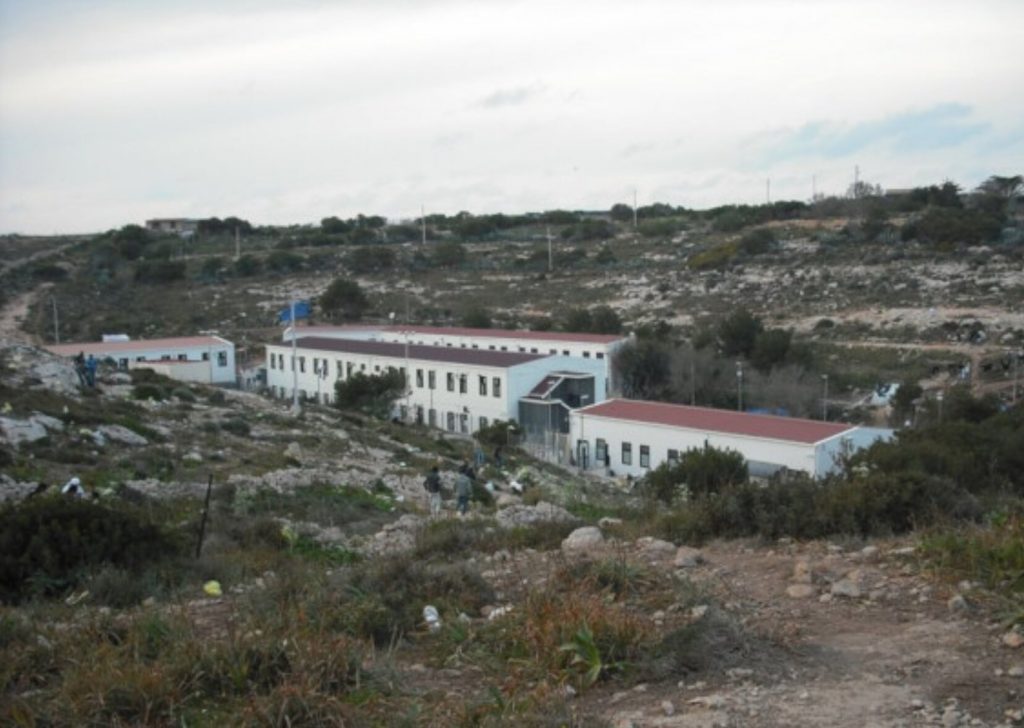
They are then taken to the island’s hotspot—a technical and impersonal term, closer to the language of control and management than to that of reception: a place of arrival, identification and transit, but not of encounter. The centre is concealed within a valley and cannot be seen from outside. Before reaching it, the road divides: tourist traffic continues along Contrada Cave, while the newly arrived are directed down another road and disappear from view. They are not outside the island, but they are outside the everyday gaze of those who visit it.
There, they receive initial assistance, are identified and have their circumstances assessed. They are subsequently transferred by ship or plane to Sicily, often to Palermo, where the relevant reception, identification or international-protection procedures continue.
The procedure is not designed to allow the two Lampedusas to meet. Nor does it prevent them from doing so; it simply does not provide for it. And what is not envisaged rarely happens.
The experience of those who arrive after crossing the Mediterranean could hardly be more different from that of those who disembark at the same harbour from a yacht or a ferry, or who arrive by plane, as I did.
© Foto HotSpot Lampedusa
But human rights do not depend on the point through which a person enters Europe, nor do they disappear when that person receives a return order. They exist precisely to protect those who are most vulnerable in the face of state power.
Yet the new European Return Regulation confirms a political shift in the opposite direction: towards greater detention, coercion and the externalisation of borders. The text approved by the European Parliament allows detention for up to 24 months, with possible extensions in certain circumstances, and provides for people to be sent to return centres in third countries with which they may have no connection whatsoever—a possibility that could place the principle of non-refoulement at risk.
Agostino and I went to see the former NATO complex, located within a military area of the island. There, this transformation may soon take physical form. Italy is completing a new facility under military jurisdiction which, according to press reports, is intended for the detention, removal and repatriation of people who have not been recognised as having the right to international protection.
Should its function be officially confirmed, the island would cease to be merely a point of entry and temporary reception and would also become a place of forced departure. The journey undertaken to reach Europe could begin to be reversed from the very same place.
Fishermen and the Coast Guard often come across empty boats. They call them ghost boats: half-submerged vessels whose passengers may have been rescued by another ship, or, perhaps more likely, claimed by the sea.
Faced with these unfinished stories, Lampedusa has created an extraordinary number of memorial sites, as though the island understood that what we grasp during a tragedy can be forgotten as soon as life returns to normal.
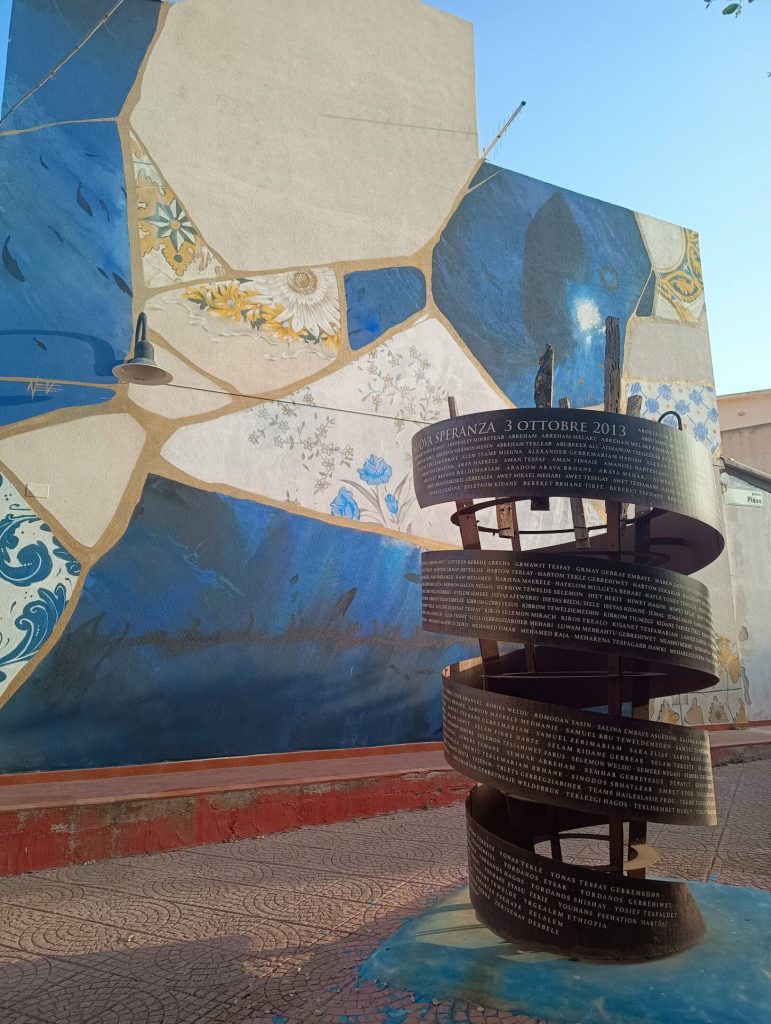
Inside Lampedusa’s church stands a large cross of Jesus made from wood recovered from shipwrecks. There is the Gateway to Europe, facing Africa and the sea. There is the statue commemorating the victims of the tragedy of October 2013, when 368 people died in a single shipwreck off the coast of Lampedusa and only 155 could be saved.
The names now inscribed on the monument had to be invented. No one knew the identities of the dead, and no one wanted them to remain merely numbers.
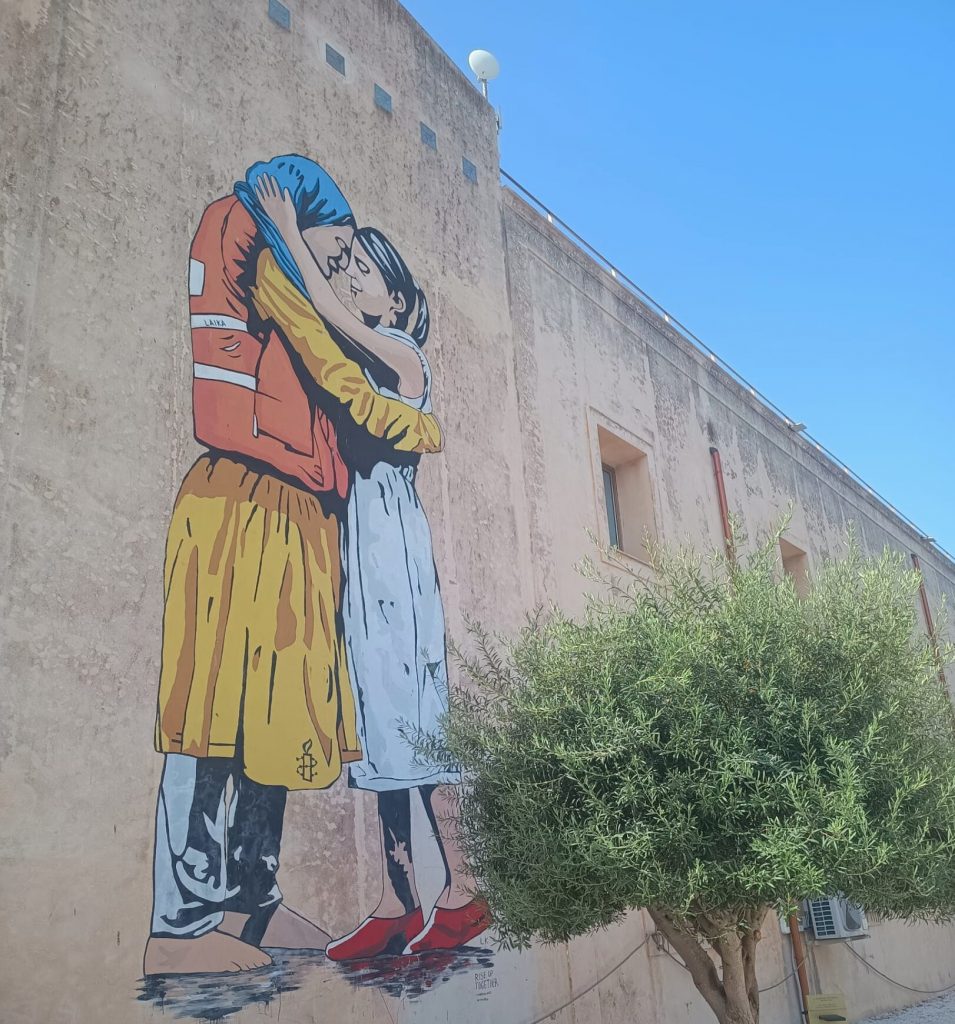
There is also the Scala Colorata, the colourful staircase dedicated to diversity. And there is the Square of Dialogue and Responsibility, bearing the moving inscription: “Who saves one life, saves the entire world.”
Puerta de Europa, Lampedusa – © Foto Leonard Glab Frontera
Because what is at stake is not merely hospitality, but a right: the right to seek asylum and not be returned to danger, a right that should not depend on having been fortunate enough to survive the sea.
The island is filled with messages about welcome, responsibility, humanity, salvation and memory. Messages that stand in contrast to the drones, the armoured vehicles, the ghost boats and the fences surrounding the hotspot. So many reminders not to forget the humanity of human beings.
Why do we need so many reminders of who we are, and of who we would like to be? Perhaps they are not a sign of failure, but of honesty. We know that we forget, and that is precisely why we create memory. We build monuments, inscribe names, reuse wood from shipwrecks and carve words into stone because we know that, without such gestures, we risk becoming accustomed to what is happening.
Because people are still dying in the Mediterranean. This year, by mid-July, at least 1,400 people had died or gone missing, including at least 928 on the central Mediterranean route towards Lampedusa alone. And these figures account only for boats that were recovered and cases whose fate could be traced. The ghost boats that continue to be found suggest that the true number may be even higher.
At the inauguration of the Gateway to Europe on June 28, 2008, a poem by Alda Merini was read for the first time. In it, the poet dreams of a giant sea turtle. Children, seaweed, flowers and drifting debris cling to its shell. It is an animal staggering under the weight of love, slow to understand and quick to bless. At the end, the turtle reveals its identity: it is the earth itself, saving those who have been cast into the water.
Perhaps that is the island’s true message: the earth does not distinguish between those who manage to cling to it. We are the ones who make that distinction.
Beauty and horror. Lampedusa belongs to both worlds, and I do not leave it untouched either, because the question that remains after departing the island is not merely what is happening in Lampedusa. The question is what Lampedusa reveals about us.
ANNEX:
Plaza del diálogo y de la responsabilidad © Foto Leonard Glab Frontera
Monumento 3 de Octubre por Vito Fiorino – © Foto Leonard Glab Frontera